Showing posts with label missionary work. Show all posts

Thursday, July 26, 2012

Tribute to a Modern Pioneer


A few weeks ago, my mom was asked to represent her local chapter of the Daughters of the Utah Pioneers.  Women in this organization are descendants of the first members of The Church of Jesus Christ of Latter-Day Saints (also known as Mormons) who settled Utah territory in the nineteenth century.  They currently work to preserve histories, artifacts and pioneer traditions.

As part of this honor, my mom requested that I write and present a short history during a program on Pioneer Day in my hometown.  This state holiday commemorates the arrival of the first Mormon pioneers in the Salt Lake Valley on July 24, 1847. 

I enjoyed hearing my mom share several stories and feel that I know her a little better as a person.
After reading this sketch of her life, you might appreciate her more too.


Tribute for Charlene Staheli
 July 24, 2012
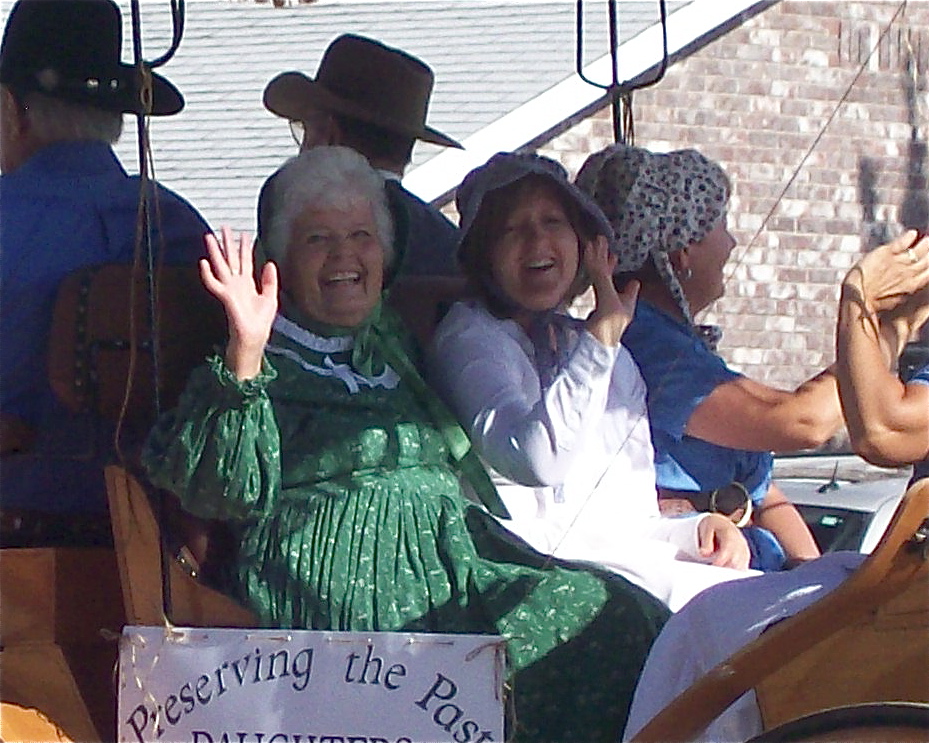
My mom and I waving at hometown crowds during the parade.
My 87-year-old dad (right) felt well enough that day to drive
the horses.
Charlene Yvonne Peacock Staheli was born into the family of Byron and Leona Peacock on Feb. 22, 1935 in Emery, Utah. The youngest of six children, she often wished her parents had named her Georgia instead, since she shared a birthday with George Washington.

In spite of a girlish distaste for her given name, Charlene appreciated her family with its rich pioneer heritage. Her Danish and English ancestors had settled Sanpete County, establishing homes and proving their faith through difficult times. Carrying on with their values, Charlene and her siblings worked together on their father's farm, performing additional chores in his dairy and beekeeping business. Charlene also learned homemaking skills, but she always preferred to drive a truck or tractor for her dad out in the fields.

News of the Pearl Harbor attack shocked the nation in 1941. Although she was only six years old, Charlene felt and witnessed some effects of World War II on her small hometown. Three older brothers enlisted in the armed forces, serving on both the Pacific and European fronts. Her older sister moved to  California where jobs were plentiful. This left only Charlene and her brother Perry at home to help their parents the best that they could. In their spare time, they joined other school-children who gathered scrap metal that was sent to munitions factories and milk weed pods with silky threads that were used to make parachutes. They took great pride in their volunteer efforts.

The strain and uncertainty took a toll on their family.  Still, their workload was lightened by plenty of homespun fun. Like pioneer children from the past, Charlene enjoyed Easter picnics at the nearby cliffs and winter sledding down chalk hills. She also viewed herself as an expert in aquatic technique because she could always touch the bottom while “swimming” in the irrigation canal.

When her father served as bishop of the Emery ward*, Charlene rang the church bell before meetings every Sunday. This ritual marked each passing week until the war ended and her brothers came home.  For a few more years, life settled into a more predictable routine.

As Charlene prepared for her senior year in high school, her parents decided to move to Oregon. They agreed to let her move in with relatives in Emery so that she could serve as yearbook editor and graduate with lifelong friends.

A summertime visit to a small community in southern Utah changed most of her plans. While staying with her brother Carlyle Peacock and his wife Elsie, Charlene made new friends and decided to transfer to the local high school. Undeterred by her status as a new girl in town, Charlene met with the principal and volunteered to serve as editor if he would allow a yearbook to be published every year. He agreed. She fulfilled her end of the bargain with characteristic flair, but her life soon took another unexpected turn.

Weeks before that fateful Halloween dance, Elsie Peacock told Stan Staheli, a local bachelor, that her “cute little niece” had come to live with them. But she hastened to add that Charlene was much too young for him. Still, he felt compelled to ask this attractive young lady for a dance. Something magical happened as they twirled across the wooden gym floor; before the night was over, he proposed.

After giving the matter some thought and prayer, Charlene consented. She and Stan were married on March 21, 1953 in the St. George temple. A short time later, she was honored as valedictorian at her high school graduation.

True to the spirit of her pioneer ancestors, Charlene continued learning and pushing forward through the joys and trials of lovingly raising a large family. Creative and resourceful, she often altered or sewed clothes for us girls and others. She could also share decades of experience on thrifting, crafting, gardening, and home decorating on blogs and that newest craze called Pinterest. She was a women ahead of her time. And who could forget her beautiful quilts? Each one is a labor of love that will be treasured by her children, grandchildren and a new generation of great-grandchildren.

In their later years, Charlene and Stan were thrilled to serve three missions** at Martin's Cove in central Wyoming. They cherished these opportunities to walk in the footsteps of valiant pioneers who sacrificed everything for their testimonies of the gospel of Jesus Christ. More importantly, they opened
their hearts to new friends and thousands of visitors—especially the youth—who traveled long distances to feel the spirit of that sacred place. As Stan and Charlene shared stories of the Willie and Martin handcart companies, downcast people felt new hope to face their own trials. Countless lives have changed.
Mom and all four of us sisters riding in a surrey with
a fringe on the top!

Today we pay tribute to our mother, grandmother, great-grandmother, neighbor, and friend. She would never presume to stand on the same level as the pioneer women whom she loves and admires, but her faith, service, and dedication surely equal theirs. Thank you for devoting your life to nurturing each member of our family, for teaching us by example to cherish our heritage and our present relationships even as we reach out to others as we journey through life. Charlene Staheli is truly a modern-day pioneer. 

*The Church of Jesus Christ of Latter-Day Saints is composed of thousands of local units called wards. Each ward is led by a bishop who supports himself and his family while he serves his congregation for several years without additional pay.

**In our church, thousands of young people and senior couples volunteer to serve full-time missions.  Young men and women usually concentrate on spreading a message of Jesus Christ and what we believe to be his restored gospel.  Senior couples serve in various ways, including work in our temples, teaching in church-supported schools, and acting as tour guides at historical sites that are significant to our religion.

Friday, November 4, 2011

Daughter, Teacher, Friend

She was born in the wake of late-summer rain and a night of intermittent labor. I had dreaded the possibility of another forceps delivery but she came after only a few minutes of pushing, a blessed conclusion to an uncertain pregnancy.

More than twenty-two years have passed since we first held our newborn daughter. We've delighted in her first impish smiles, her princess fantasies and desires to emulate all things good and beautiful.

Yes, she took part in childhood squabbles. We had to enforce expectations that she complete schoolwork on time and her tendency to daydream once resulted in a wrecked car. But she walked away with minor injuries and we're grateful that she could enter a new phase of life.

One month ago we traveled to Provo where she was scheduled to enter the Missionary Training Center. She'd packed cardigans, skirts and blouses along with a few personal items. She'd posted a witty Facebook farewell. She'd printed her unfinished novel, tucked it away and placed her books on my bedroom shelf.

Autumn rain swept over the Wasatch mountains as we hurried through one last errand at the University Mall and our final meal together. We joked and laughed, trying to lighten the reality that she would be leaving for eighteen months. Then we crowded into our car and headed west with a steady flow of noon-hour traffic.

Unfamiliar with this area, I didn't expect to see the Utah Valley Regional Medical Center as my husband changed lanes and prepared to turn south. But the sight of the large hospital triggered memories and emotions that were impossible to check.

I remembered a frigid winter morning in 1989. As a young mother living in Midway, Utah I'd told my husband good-bye before he headed to another day of teaching school in neighboring Heber City. Then my spontaneous decision to read to our two-year-old son turned terribly wrong. One moment I was enjoying his clever comments as I basked in my happiness at being pregnant again. Everything changed as I felt something pop deep inside and a gush of fluid that turned out to be blood.

After a series of frantic phone calls and a trip over icy roads to the clinic, my husband and I sat, stunned, as our doctor said that I had probably lost the baby. Trying to comfort us, he mentioned that this wasn't uncommon in the first trimester. Then he sent us to Provo for an ultrasound.

A few days before, my younger brother had traveled up the snowy canyon from BYU to assist my husband in giving me a priesthood blessing. It's a tradition that we started when we learned that I was carrying our first child. But the comforting assurance I had received concerning this second pregnancy didn't seem to make sense. I tearfully voiced my doubts as we circled the half-frozen waters of Deer Creek Reservoir. My husband squeezed my hand and said, "Remember what we were promised."

It wasn't the first time I'd leaned on his faith. Nor the last.

Half-an-hour later I lay in a stark room as the ultrasound technician spread icy gel on my still-flat stomach. I hardly dared to look up at the dark screen, but we soon watched in amazement as the small yet perfect image of a baby kicked and wriggled into view. At last I felt the warm confirmation my husband had known all along: this child was meant to live and I would do everything in my power to make it so.

After weeks of bed rest, prayers, and plenty of red raspberry tea, the bleeding eventually subsided. I had to limit my activities for the rest of the pregnancy but, considering the seriousness of a partially ruptured placenta, our doctor said my recovery was remarkable indeed.

Twenty-six years into our marriage, my husband and I are dealing with different challenges. Some require high levels of patience (which I frequently fail to practice). They can't cured with a physical remedy or prayed away.

But the last backward glimpse of our daughter smiling as she walked down a rain-washed sidewalk towards another turn in her young life reaffirmed my determination to meet the unknown with faith.

I continue to feel amazement at her growth and the insights she shares in weekly letters or emails. Learning a new language (in her case, Spanish) in a limited amount of time is hard and other aspects of life at the Missionary Training Center are intense is ways that I don't understand. Her words express hope and optimism, however, and I don't worry. She's learned what it means to pray with intent--the intent to do her part--and she's beginning to reap the blessings, even if they are as simple as a quiet assurance that she can press on.

That alone is a reminder that I need on a regular basis. I'm thankful that, in spite of my weaknesses and mistakes, our children are growing into some of my greatest teachers and friends.

Sunday, March 13, 2011

Finding Cumorah

In the summer of 1983, I had the opportunity to be in the cast of The Hill Cumorah Pageant. I was a wicked Nephite woman who followed the crowd in condemning Abinadi and my "missionary companion" was one of Kind Noah's concubines. (That was my wild fling!) Incidentally, a few of the college-age girls harbored secret crushes on the ,single male actors. They were fairly evenly divided between Team Abinadi and Team Captain Moroni. :)

I kept a journal faithfully back then and enjoyed touring many historic sites in the area. Being in the pageant was a spiritual experience as well since it depicts many of the Book of Mormon prophets who testified of Christ and His appearance to the Nephites.

I hated to leave New York when it was time to return home, but I wrote a poem about the Hill Cumorah. A few years and many drafts later, the poem was published in a contest issue of The New Era.

When the LDS Church celebrated Joseph Smith's 200th birthday in 2005, I pulled out the magazine and read the poem again. It had a couple of good lines but most of it was too obscure. Also, my perspective on Joseph Smith and what had occurred at the Hill Cumorah had changed. My oldest son was close to the same age as Joseph Smith when he first saw the ancient record of the Nephite people. In fact, my son had just received his mission call and was preparing to testify of The Book of Mormon and other truths of the restored gospel.

I changed the title and decided to rewrite the poem; the result is more cohesive as it focuses on the seasons of Joseph Smith's burgeoning faith. As a mother, I was struck by how vulnerable he must have felt in his youth as he learned of his life's mission. I used many natural images to evoke those emotions, especially the in first stanzas. While reworking the poem, I also gained a greater appreciation of Joseph's courage in spite of adversity and his lack of education or experience. I hope the last stanza in this poem expresses my gratitude for all that he accomplished.


Finding Cumorah
Manchester County, New York, 1823

Late September
washes a season's green
beyond field and village
and age seventeen.
only leaves
rinsed in afterglow
stir at Joseph's homespun
passing.

He once knelt
in April grove,
drenched with that glory
of Father and Son.
Then summer wove roots
through his harrowed soul
as those parched by mockery
claimed the heavens
closed.

Autumn wind
shimmers into the trees,
quickening vision
of his pending task:
these hands will
lift voices
silenced by stone,
fullness like morning
tide gathering
home.


Since this ended up being a completely different poem, I submitted it to the Ensign and then to the New Era where it was published in the September 2009 issue. A pdf of it is available online.