The other day I read a facebook post about "not wishing away" the stages of our children's lives. I'm not a close friend of the woman who said she's enjoyed her babies, toddlers, teens, and adult children. The name of another mom who commented, "I loved it all and now laugh about what used to make me mad" (punctuated by cute pink hearts) is just that. A stranger's name.
I'm happy for them. The world needs mothers who cherish their families. And I try to do the same.
But I don't link motherhood with cute pink hearts.
At the risk of appearing heartless on Facebook (that mecca of mommy mushiness), I commented that parenthood hasn't been a joyful journey for me. My husband and I love the five children who joined our family. We wanted them all and treasure the good times. But dealing with some of their developmental struggles and my own depression continues to create challenges every step of the way.
While acknowledging that nobody likes everything about motherhood, my acquaintance responded that she "totally gets it", then wrapped up her comment with a positive-mental-attitude quote.
Dear mothers who work tirelessly to raise good children and have every right to rejoice in your lives, I admire you. But you don't understand my experience any more than I understand the trials that shape your reality. I'll never presume that I do.
I don't remember a time when I wasn't chronically depressed. I didn't begin to address the cause until after all our children were born. Much as I regret lost opportunities to laugh, connect, and nurture, depression often feels like swimming through jello and I sometimes don't have the energy to do much more than cook dinner and bite my tongue. Too often I don't even do that.
Even though my husband and I wanted children, the joy I hoped to feel was crushed by the weight of responsibility when our first son squirmed on my naked chest. I had to help him latch onto a breast, I had to facilitate bonding within his first few minutes of life while I winced with pain and the doctor stitched up extensive tearing. The Bradley natural childbirth "bible" had promised that many new mothers could walk out of their delivery rooms. But I fainted from blood loss when my husband tried to help me to the bathroom that night. A nurse inserted a catheter into my nether regions and there I was. Weak. Swollen. Bleeding profusely. And, worst of all, panicked about caring for a helpless child.
Night after night, I rocked and cried and nursed him in the darkness of a tiny room that was already crowded with canned wheat, beans, and powdered milk. The borrowed cradle wouldn't fit by our bed and my husband needed sleep so that he could work and go to school. With no stroller, car, or telephone, I rarely communicated with anyone else or went anywhere. Instead, I tried to rest, do basic chores, and nurse the baby. Then nurse him again and again. I felt inadequate around my mother-in-law who cooed and cuddled him with complete adoration shining in her eyes. The only words I remember my mother saying were, "You need to talk to that baby more."
I couldn't relate to magazine photos of stylish mothers beaming at their plump little cherubs. Maybe that's why articles about postpartum depression didn't register with my sleep-deprived brain. My doctor never asked me about symptoms. It was 1987.
I felt betrayed by my body that took so long to heal and I couldn't forget the shame of screaming as the doctor's forceps dragged my baby into the world. I loved our son, but in a pattern that spilled into my other babies' lives, that emotion was clouded by extreme anxiety over meeting constant, pressing needs. Months passed before I could laugh.
Yet women at church and the grocery store told me to enjoy him while he was small.
Babies grow up so fast.
For twenty-eight years, I've struggled with physical exhaustion while potty-training unwilling toddlers. Dealing with food issues related to ADHD that eventually affected their growth. Screaming tantrums that escalated into one child's preteen years whenever my husband and I required him to do chores. Every. Time. No matter how much we tried to stay calm. No matter how consistently we refused to cave in.
Several years, disappointments, and thousands of dollars later, we found professional help. By this time the two sons who were having the most challenges were approaching adolescence. One has Asperger's syndrome and the other ADHD. Although we reeled with the lifelong implications, we tried to educate ourselves and their teachers, and to apply solutions. .
It wasn't that simple.
The boys balked at implementing school strategies or being singled out for help with study and social skills. Professional advice sometimes fell on deaf ears. Fed by the fires of contention that energized their spirits and often drew me in, I lived a mercurial existence of frustration and despair. Anger over missed assignments, remediation, and high school teachers who thought coaching was more important than honoring our repeated requests for information about failing grades until it was too late. Sadness over our sons' social isolation when moms posted Facebook photos of their teens dressed up for girls' choice dances. Frustration at student athletes and other peers who didn't think about being inclusive, then judged one son for not serving a L.D.S. mission at age 19. Or busy church leaders who listened absently to my husband's concerns, then tried to compensate by saying, "I love that kid. He's really O.K."
I didn't cry at their high school graduations. Exhausted with relief yet smiling, I watched my husband take photos. One son allowed me to offer a quick hug. The other didn't. Then we pressed forward to appropriately help them navigate more complex stages of their lives, while trying to be there for three other children with talents, dreams, and their often-unmet needs.
Long ago, I accepted the fact that these sons wouldn't achieve the usual milestones at the same rate as their peers. In most ways, their paths have been completely different the typical small-town teen.
So has mine.
I'm often stumbled, then stayed huddled on bruised hands and knees, so consumed by my own pain that I failed to offer a hand to a struggling child. I've never been a fount of wisdom, patience, or unconditional love. That would be easier to bear if I could look back and see personal progress.
Right now I can't.
So motherhood weighs heavily as I try to muster the willpower to dispel depression. Again.
Circumstances will never be perfect, but by the grace of God, we are starting to heal and connect on some levels. Sometimes I glimpse a time when all of our children gain independence. I hang onto that and feel intensely thankful when they express forgiveness for my past and present mistakes.
I've shed grateful tears when someone reached out and helped our vulnerable sons. When young women leaders modeled happy motherhood for my daughter, lending strength to their convictions that raising families is a divine gift.
I was there once, a young girl who took it all in. But children aren't adorable playthings to dress up and display in baptism white, prom tuxes, or wedding gowns. I'm only beginning to understand the magnitude of patience and love a young adult child still requires, even when he shoves me aside in a quest to deny hard realities of developmental challenges. To be like everyone else.
I gaze at the heights that most children reach at 16, 18, or 25. We've got so far to climb. He's too big to carry or force up the steep slope. The only thing left is to persuade, to encourage. To keep seeking help.
My husband and I never anticipated this kind of journey. Most of the time we're bone-tired. But we won't give up; every stage requires readjusted expectations, then we trudge on.
People don't need to understand our reality. Just realize that it's not the same as yours. And tidy slogans about positive thinking sometimes feel like salt on blistered feet.
In the meantime, I'll try harder to find delight in unexpected moments of love and humor. Or look into the tired eyes of other mothers at church and focus on what they might not express in words. I'll tell them they're doing just fine. Even if they don't love the new-baby or teenage years of their children. Even if they're barely hanging on until the next stage finally arrives.
Sometimes that's all a mother can do. As a believer in Christ's atoning grace, I pray it's enough.

Saturday, July 25, 2015

Sunday, May 3, 2015
The Best of Times

Fast forward to April 1981. Now seventeen, I took a deep breath and waited for the last student to amble from the language arts classroom. Through the open windows of the crusty small-town high school, adolescent laughter and conversation laced the soft afternoon air like wispy seeds from the cottonwood trees. I yearned to hurry down the hill and turn corners in a merciful split second, to shut my bedroom door on the news a friend had shared that morning. During my absence on a Spanish club trip the week before, my favorite teacher had told at least one class that I'd rejected her son's invitation to the upcoming prom.
In fifth grade, I'd envied him because his mom reportedly paid him $5.00 every time he read a book. In eighth grade, I nurtured a brief crush on him before I made the conscious decision to avoid teenage romance. (Not that any boys noticed.) Since we started high school, he hadn't talked to me about anything except yearbook photos or assignments for the school newspaper.
More hurt than angry, I walked to Mrs. R.*'s desk and struggled to maintain eye contact as I set the story straight. Few students dared ignite her temper; one of the few professional women who'd grown up in our southern Utah town, she governed her students with a firm hand and lightning-sharp flashes of humor. I had blossomed from her encouragement of my attempts at writing and had willingly spent countless hours working as assistant newspaper editor. How she could believe I had turned down her son because he wasn't a practicing Mormon? I was religious, but not a prude.
After a long pause, she said, "I owe you an apology. When Darren* was trying to decide who to ask to the dance, I suggested you. Because--forgive me--I thought you might be one who'd be left out."
This painful truth didn't sink in as I smiled, said things were O.K., and walked a wind-blown mile to my home on the north end of town. It didn't penetrate my fog of anxiety as I slipped into ratty jeans and a t-shirt to paint a mural of an elegant garden for the prom. The large butcher-paper masterpiece taped to my bedroom wall would be hung as a backdrop for photographs of smiling couples during the dance. During the early stages of painting, the head cheerleader and her best friend came to see how much progress I'd made. Smiling and laughing, they returned to their decorating duties at the school, where they told other classmates the mural looked terrible. Even though their cattiness left me fuming, I doggedly painted a graceful tree loaded with blossoms that my untrained hand tried to accent with illusions of light.
In fifth grade, I'd envied him because his mom reportedly paid him $5.00 every time he read a book. In eighth grade, I nurtured a brief crush on him before I made the conscious decision to avoid teenage romance. (Not that any boys noticed.) Since we started high school, he hadn't talked to me about anything except yearbook photos or assignments for the school newspaper.
More hurt than angry, I walked to Mrs. R.*'s desk and struggled to maintain eye contact as I set the story straight. Few students dared ignite her temper; one of the few professional women who'd grown up in our southern Utah town, she governed her students with a firm hand and lightning-sharp flashes of humor. I had blossomed from her encouragement of my attempts at writing and had willingly spent countless hours working as assistant newspaper editor. How she could believe I had turned down her son because he wasn't a practicing Mormon? I was religious, but not a prude.
After a long pause, she said, "I owe you an apology. When Darren* was trying to decide who to ask to the dance, I suggested you. Because--forgive me--I thought you might be one who'd be left out."
This painful truth didn't sink in as I smiled, said things were O.K., and walked a wind-blown mile to my home on the north end of town. It didn't penetrate my fog of anxiety as I slipped into ratty jeans and a t-shirt to paint a mural of an elegant garden for the prom. The large butcher-paper masterpiece taped to my bedroom wall would be hung as a backdrop for photographs of smiling couples during the dance. During the early stages of painting, the head cheerleader and her best friend came to see how much progress I'd made. Smiling and laughing, they returned to their decorating duties at the school, where they told other classmates the mural looked terrible. Even though their cattiness left me fuming, I doggedly painted a graceful tree loaded with blossoms that my untrained hand tried to accent with illusions of light.
A formal dress hung in my closet, but it wasn't the peach-colored Gunne Sax confection that had caught my eye during a shopping trip in St. George. Instead, I had conceded to my mom's
sweet-voiced preference for an ivory gown with a three-tiered skirt that washed out my pale complexion. But
the dress didn't make any difference. My left hand ached from hours of wielding a paintbrush. My hair, face, and clothes were smeared with a garish display of colors. As junior class president, I felt like a dependable work-horse who would attend the dance just long enough to endure the traditional class promenade and coronation of the prom royalty. Then I planned to drive home, fall into bed, and sleep.
Two nights
before the big event, my mom called me downstairs to answer the phone. It was a Rob*, a young man who had recently returned from a L.D.S. mission. (In our town, returned missionaries sometimes dated high school girls.) In a
hesitant voice, he asked if I would go with him to the dance. Surprised, yet
ecstatic, I said yes.
The evening
of the prom washed the high desert hills with layers of lavender sunset. After removing the cooled electric rollers from my naturally straight hair, I tried to brush layers of curls into Farrah Fawcett perfection. At last I was primped, painted, and hair-sprayed for my mystery date. When I walked downstairs in the ivory dress, my oldest sister's fiancee gaped in admiration and exclaimed, "Here comes the bride!"
I blushed in discomfort and wobbled as fast as my high heels allowed to the living room to wait.
I blushed in discomfort and wobbled as fast as my high heels allowed to the living room to wait.
Wearing a dark brown suit leftover from his missionary days, Rob finally knocked on the
front door. He was shorter than I expected and wouldn't look me in the eye as I invited him inside. Finally, he shifted his feet and held out a large corsage of deep red roses.
Beaming with pride, my mom volunteered to pin the corsage on the crocheted lace ruffle that accented the neckline of my dress. But my hands shook as I tried to secure a boutonniere on the lapel of Rob's suit coat. This young man was a complete stranger whose shyness aroused my sympathy when he spoke in our church meeting months before. He didn't want to be here. What would we say to each other for the next three hours?
Once we arrived at the school multipurpose room, the throbbing beat of the live band solved most of the dilemma. Neither of us knew how to dance. But in that crepe paper palace of the early 1980s, we merely blended into the adolescent herd, exchanging forced smiles as we rocked from one foot to another or endured slow-song shuffles under a suspended disco ball. Between songs, our attempts to prop up conversation dissolved into the surrounding hum of scattered phrases and a haze of musk aftershave mingled Jean Nate cologne. The last vestiges of my pre-date excitement vanished like careful bites of anemic sheet cake slathered with frosting that tasted too much like shortening.
Rob never asked the photographers to take our picture in front of my painted garden. My mom snapped a Polaroid photo of my dad dancing with me after the promenade, while a duo of classmates sang a strained imitation of the Styx hit single, "The Best of Times." Then the head cheerleader was crowned prom queen, with her best friend as one of the attendants. All of the royalty smiled for Darren's yearbook camera in front of my blossoming tree.
Rob and I
didn't say much during the drive home. But he shook my hand on the front porch
and said, "Hey, we'll have to do this again some time."
He never
called and it's just as well. On Monday, my friend admitted that Rob had asked me to dance as a kind of service project. His plan to double-date had fallen through. Eventually my corsage was shoved to the back of our fridge where it wilted behind gallons of milk and a five-pound block of Brooklawn cheese.
*Names have been changed.
*Names have been changed.
Friday, March 21, 2014
One Word
The other day, I turned fifty. It was just another day, but I'm glad my two oldest children remembered to call. Maybe my husband and I will think of something fun to do this weekend. Instead of expecting birthday flowers or eating out, which I no longer enjoy, I told him I would like his help planting something permanent and attractive in an ugly area of our front yard. Last week, we chose some plants and estimated the cost. After we know about our financial situation, we'll decide whether or not to splurge a bit on the project.
During my last year in the forties decade, the pace of life took my breath away. Last April, our daughter returned from eighteen months of service on an L.D.S. mission. A week later, our third child left to serve a mission. Two months later, our oldest son married a wonderful girl. I didn't document any of these major events in words, except in my personal journal. The rest of the year? It's been loaded with church service and daily life with extended family, a husband, and our three children who remained at home. I also completed a freelance editing project (400-page novel) and wrote two Christmas novelettes that I submitted to publishers. (All of them rejected the manuscripts. Oh, well.)
I've outlined the big events, but not their emotional impact. But I felt that I finally progressed in the following ways:
It's hard to achieve when so much has to be done. Too often it gets smothered by the details of life. Take this past year, for example. Good things happened, but I experienced them while on emotional autopilot. I know it's a hallmark of depression, but it's not how I want to live and I'm sure it's not what God intends for us.
I didn't know what to do differently. Faced with the necessity of feeding crowds of people at our family events and cobbling together a wedding open house on a nonexistent budget (we had to pay hundreds in taxes instead of getting the refund I was counting on), I just shut down. Yes, I acted like biblical Martha's clone, but hiring a caterer was not an option. I didn't have a fairy godmother to wave food, formal clothing, or even minimal wedding decor into existence. So, with the help of family and friends, we "rolled up our sleeves" and did it ourselves.
I truly despise focusing on what I view as superficial aspects of my life that is now at least half-way over. I don't want to spend much time or thought on the practicalities or mere survival. I'm sure plenty of others feel the same. But, unlike Henry David Thoreau, most of us can't spend years in solitude. At this stage of life, a significant portion of my energy must be devoted to feeding, clothing, and caring for my family. God has been so good to me that I feel obligated to do my best serving the women in my ward (congregation) by planning social and service-oriented activities. As a compromise, I'll try to capture some moments of silence and wonder through the course of each day. Still, some extended time at Walden Pond sounds like the perfect birthday present in my book!
During my last year in the forties decade, the pace of life took my breath away. Last April, our daughter returned from eighteen months of service on an L.D.S. mission. A week later, our third child left to serve a mission. Two months later, our oldest son married a wonderful girl. I didn't document any of these major events in words, except in my personal journal. The rest of the year? It's been loaded with church service and daily life with extended family, a husband, and our three children who remained at home. I also completed a freelance editing project (400-page novel) and wrote two Christmas novelettes that I submitted to publishers. (All of them rejected the manuscripts. Oh, well.)
I've outlined the big events, but not their emotional impact. But I felt that I finally progressed in the following ways:
- Although we've lived in our town for decades and contributed to our church and schools, I learned that we are not very important after all. At first, it was a painful lesson as a rather small fraction of invited guests trickled into our son's wedding open house. But the happy couple didn't care. Why should I? Afterwards, I made a list of what we'll do differently next time one of our children gets married. I was glad we'd lived within our means, keeping this event a modest affair. I felt gratitude for those who helped. I also reassessed my negative emotions that were really hurt feelings left over from junior high. So what if we're not the "cool kids" in town? Social status doesn't matter. How liberating to renew that affirmation in a different stage of life.
- I'm beginning to believe in miracles again. After years of trying to honestly deal with hard realities, I've often felt cynical and pessimistic. It's been hard to pray or muster enough faith to believe in divine help. It's taken some time to regain perspective, but I can't deny evidence of God's help through people who have touched my life and the lives of others in my family, especially one son. He wouldn't be where he is without it.
- The best way for me to confront writer's block is to . . . write! Just write through the fear of what others might think and the fear that what I produce isn't good enough. Write through the falsehood that words have to be polished perfection in the first draft. That's how I finally felt the joy of creating something again, even though it was difficult. Like giving birth, it's worth the pain of hard labor.
It's hard to achieve when so much has to be done. Too often it gets smothered by the details of life. Take this past year, for example. Good things happened, but I experienced them while on emotional autopilot. I know it's a hallmark of depression, but it's not how I want to live and I'm sure it's not what God intends for us.
I didn't know what to do differently. Faced with the necessity of feeding crowds of people at our family events and cobbling together a wedding open house on a nonexistent budget (we had to pay hundreds in taxes instead of getting the refund I was counting on), I just shut down. Yes, I acted like biblical Martha's clone, but hiring a caterer was not an option. I didn't have a fairy godmother to wave food, formal clothing, or even minimal wedding decor into existence. So, with the help of family and friends, we "rolled up our sleeves" and did it ourselves.
I truly despise focusing on what I view as superficial aspects of my life that is now at least half-way over. I don't want to spend much time or thought on the practicalities or mere survival. I'm sure plenty of others feel the same. But, unlike Henry David Thoreau, most of us can't spend years in solitude. At this stage of life, a significant portion of my energy must be devoted to feeding, clothing, and caring for my family. God has been so good to me that I feel obligated to do my best serving the women in my ward (congregation) by planning social and service-oriented activities. As a compromise, I'll try to capture some moments of silence and wonder through the course of each day. Still, some extended time at Walden Pond sounds like the perfect birthday present in my book!
Tuesday, January 1, 2013
New Year's Day 2013: looking forward, looking back
Wrapped in a fluorescent green blanket, I'm sitting by our wood-burning stove resolved to write. Not a Facebook status. Not a glowing recap of our Christmas holiday. Not even a list of New Year's resolutions.
I'm tired. Taking a college class pulled me out of an emotional rut that had deepened by summertime, but I never figured out how to do Christmas with teenage and young adult sons. It's been wonderful to have all four of them home for over a week, but I miss our daughter, who's been serving an L.D.S. mission for almost 15 months.
Only our youngest showed much interest in a few traditions we've maintained over the years. He sang/danced in a half-dozen venues that motivated me to try to maintain a calm atmosphere. I didn't always succeed. Think last-minute quests for a lost choir t-shirt and digging through boxes for a pair of slacks that were once part of a suit I'd bought new for an older son. No luck. He ended up wearing different shades of formal black when he sang a solo in a local performance of the Messiah. It worked, but I wonder how we managed when Christmas concerts were multiplied by three kids.
With ADHD and Asperger's added to the holiday mix, frequent moments of chaos inevitably ensued. I've tempered my expectations about peaceful Christmas Eve programs or elaborate service projects. Embracing the humor of situations works much better instead and we enjoyed plenty of laughs.
Besides splurging to see The Hobbit, it was hard to think of something that everyone (with their vastly different personalities and interests) would enjoy. Mandatory participation defeats the purpose of activities, in my book. (Exception: attending family Christmas parties. Now in their seventies and eighties, our parents won't be around long.)
In light of recent publicity about the Connecticut school shooter who had Asperger's, I hope our high-schooler's peers are kind. I've read a couple of blog posts by other moms with kids on the autism spectrum. Many of their thoughts echo mine. I hope society and future employers value our son's gifts, which surpass his challenges. There's got to be a place for him in this world.
I am tired. But 2013 is here and I have noticed the hand of the Lord in my life. Because of Him, I'm stronger and better-prepared to face the future than I was twelve months ago.
Let the new year begin one day at a time.
d
I'm tired. Taking a college class pulled me out of an emotional rut that had deepened by summertime, but I never figured out how to do Christmas with teenage and young adult sons. It's been wonderful to have all four of them home for over a week, but I miss our daughter, who's been serving an L.D.S. mission for almost 15 months.
Only our youngest showed much interest in a few traditions we've maintained over the years. He sang/danced in a half-dozen venues that motivated me to try to maintain a calm atmosphere. I didn't always succeed. Think last-minute quests for a lost choir t-shirt and digging through boxes for a pair of slacks that were once part of a suit I'd bought new for an older son. No luck. He ended up wearing different shades of formal black when he sang a solo in a local performance of the Messiah. It worked, but I wonder how we managed when Christmas concerts were multiplied by three kids.
With ADHD and Asperger's added to the holiday mix, frequent moments of chaos inevitably ensued. I've tempered my expectations about peaceful Christmas Eve programs or elaborate service projects. Embracing the humor of situations works much better instead and we enjoyed plenty of laughs.
Besides splurging to see The Hobbit, it was hard to think of something that everyone (with their vastly different personalities and interests) would enjoy. Mandatory participation defeats the purpose of activities, in my book. (Exception: attending family Christmas parties. Now in their seventies and eighties, our parents won't be around long.)
In light of recent publicity about the Connecticut school shooter who had Asperger's, I hope our high-schooler's peers are kind. I've read a couple of blog posts by other moms with kids on the autism spectrum. Many of their thoughts echo mine. I hope society and future employers value our son's gifts, which surpass his challenges. There's got to be a place for him in this world.
I am tired. But 2013 is here and I have noticed the hand of the Lord in my life. Because of Him, I'm stronger and better-prepared to face the future than I was twelve months ago.
Let the new year begin one day at a time.
d
Thursday, July 26, 2012
Tribute to a Modern Pioneer
A few weeks ago, my mom was asked to represent her local chapter of the Daughters of the Utah Pioneers. Women in this organization are descendants of the first members of The Church of Jesus Christ of Latter-Day Saints (also known as Mormons) who settled Utah territory in the nineteenth century. They currently work to preserve histories, artifacts and pioneer traditions.
As part of this honor, my mom requested that I write and present a short history during a program on Pioneer Day in my hometown. This state holiday commemorates the arrival of the first Mormon pioneers in the Salt Lake Valley on July 24, 1847.
I enjoyed hearing my mom share several stories and feel that I know her a little better as a person.
After reading this sketch of her life, you might appreciate her more too.
Tribute for Charlene
Staheli
July 24, 2012
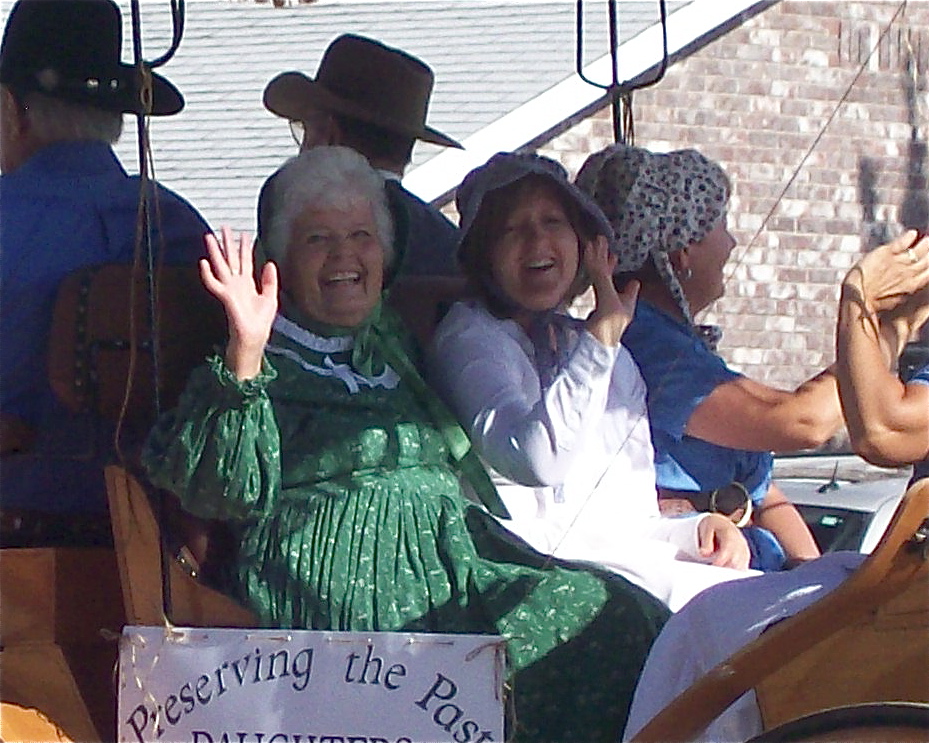 |
| My mom and I waving at hometown crowds during the parade. My 87-year-old dad (right) felt well enough that day to drive the horses. |
Charlene
Yvonne Peacock Staheli was born into the family of Byron and Leona
Peacock on Feb. 22, 1935 in Emery, Utah. The youngest of six
children, she often wished her parents had named her Georgia instead,
since she shared a birthday with George Washington.
In spite
of a girlish distaste for her given name, Charlene appreciated her
family with its rich pioneer heritage. Her Danish and English
ancestors had settled Sanpete County, establishing homes and proving
their faith through difficult times. Carrying on with their values,
Charlene and her siblings worked together on their father's farm,
performing additional chores in his dairy and beekeeping business.
Charlene also learned homemaking skills, but she always preferred to
drive a truck or tractor for her dad out in the fields.
News of
the Pearl Harbor attack shocked the nation in 1941. Although she was
only six years old, Charlene felt and witnessed some effects of World
War II on her small hometown. Three older brothers enlisted in the
armed forces, serving on both the Pacific and European fronts. Her
older sister moved to California where jobs were plentiful. This left only Charlene and
her brother Perry at home to help their parents the best that they
could. In their spare time, they joined other school-children who gathered scrap metal that was sent
to munitions factories and milk weed pods with silky threads that
were used to make parachutes. They took great pride in their
volunteer efforts.
The strain and uncertainty took a toll on their family. Still,
their workload was lightened by plenty of homespun fun. Like
pioneer children from the past, Charlene enjoyed Easter picnics at
the nearby cliffs and winter sledding down chalk hills. She also
viewed herself as an expert in aquatic technique because she could
always touch the bottom while “swimming” in the irrigation canal.
When her
father served as bishop of the Emery ward*, Charlene rang the church
bell before meetings every Sunday. This ritual marked each passing week until the war ended and her brothers
came home. For a few more years, life settled into a more predictable routine.
As
Charlene prepared for her senior year in high school, her parents
decided to move to Oregon. They agreed to let her move in with
relatives in Emery so that she could serve as yearbook editor and
graduate with lifelong friends.
A
summertime visit to a small community in southern Utah changed most of her plans. While
staying with her brother Carlyle Peacock and his wife Elsie, Charlene
made new friends and decided to transfer to the local high school.
Undeterred by her status as a new girl in town, Charlene met with the
principal and volunteered to serve as editor if he would
allow a yearbook to be published every year. He agreed. She
fulfilled her end of the bargain with characteristic flair, but her
life soon took another unexpected turn.
Weeks
before that fateful Halloween dance, Elsie Peacock told Stan Staheli,
a local bachelor, that her “cute little niece” had come to live
with them. But she hastened to add that Charlene was much too young
for him. Still, he felt compelled to ask this attractive young lady
for a dance. Something magical happened as they twirled across the
wooden gym floor; before the night was over, he proposed.
After
giving the matter some thought and prayer, Charlene consented. She and
Stan were married on March 21, 1953 in the St. George temple. A
short time later, she was honored as valedictorian at her high school
graduation.
True to
the spirit of her pioneer ancestors, Charlene continued learning and
pushing forward through the joys and trials of lovingly raising a
large family. Creative and resourceful, she often altered or sewed
clothes for us girls and others. She could also share decades of
experience on thrifting, crafting, gardening, and home decorating on
blogs and that newest craze called Pinterest. She was a women ahead of her time. And who could forget
her beautiful quilts? Each one is a labor of love that will be
treasured by her children, grandchildren and a new generation of
great-grandchildren.
In their
later years, Charlene and Stan were thrilled to serve three missions** at Martin's Cove in central Wyoming. They cherished these
opportunities to walk in the footsteps of valiant pioneers who
sacrificed everything for their testimonies of the gospel of Jesus
Christ. More importantly, they opened
their
hearts to new friends and thousands of visitors—especially the
youth—who traveled long distances to feel the spirit of that sacred
place. As Stan and Charlene shared stories of the Willie and Martin
handcart companies, downcast people felt new hope to face their own trials. Countless lives have changed.
 |
| Mom and all four of us sisters riding in a surrey with a fringe on the top! |
Today we
pay tribute to our mother, grandmother, great-grandmother, neighbor,
and friend. She would never presume to stand on the same level as
the pioneer women whom she loves and admires, but her faith, service,
and dedication surely equal theirs. Thank you for devoting your life
to nurturing each member of our family, for teaching us by example to
cherish our heritage and our present relationships even as we reach
out to others as we journey through life. Charlene Staheli is
truly a modern-day pioneer.
*The Church of Jesus Christ of Latter-Day Saints is composed of thousands of local units called wards. Each ward is led by a bishop who supports himself and his family while he serves his congregation for several years without additional pay.
**In our church, thousands of young people and senior couples volunteer to serve full-time missions. Young men and women usually concentrate on spreading a message of Jesus Christ and what we believe to be his restored gospel. Senior couples serve in various ways, including work in our temples, teaching in church-supported schools, and acting as tour guides at historical sites that are significant to our religion.
Friday, March 30, 2012
Night at the Library
She sprang to life as everything I wasn't in seventh grade: slender, vivacious, with delicate features, warm brown eyes, and abundant auburn curls. Gracefully drifting through aristocratic circles in nineteenth-century Austria, my fictional heroine wore lovely gowns, danced to Strauss waltzes, and won the heart of a handsome hero when they met on a dark and stormy night.
He had a thing for brunettes.
He had a thing for brunettes.
My first attempt at writing a novel was shamelessly melodramatic, but I'd just read Gone With the Wind in furtive solitude (mostly when my mom thought I was cleaning my room). I was hooked on historical fiction, which fueled my interest in writing and shaped some of my early notions about romantic love.
During high school, I fell for a couple of boys but realized that I was no beau-catching Scarlett O'Hara. Quite the opposite, as Elizabeth Bennett once said. Instead of filling the role of wallflower at weekend dances, I made a conscious decision to focus on reading and writing.
The idyllic heroine stayed with me, finally "consenting" to climb down from her pedestal and get real. She evolved into a girl with emotional baggage who learned to love and trust over a long period of time. The premise of my masterpiece was hardly original and some scenes still oozed cheese, but I scribbled nearly three hundred pages before young adulthood changed my perspective again.
The idyllic heroine stayed with me, finally "consenting" to climb down from her pedestal and get real. She evolved into a girl with emotional baggage who learned to love and trust over a long period of time. The premise of my masterpiece was hardly original and some scenes still oozed cheese, but I scribbled nearly three hundred pages before young adulthood changed my perspective again.
Two weeks after high school graduation, I left home to get a head start on college. The unfinished tale stayed behind in a series of spiral notebooks that I hid in a bedroom drawer.
A mostly studious English major, I tried to dissect sonnets and delve for deep interpretations of literary prose. Romance was relegated to the rare novel that I read over lunch when I needed a break from T.S. Eliot or John Donne (as in deceased poets, not prospective dates).
Just before spring break in 1984, I was studying for finals at the campus library. I'd noticed a tall dark stranger among the fourth floor regulars but when he stopped at my table that night, something clicked. We ended up discussing art history, our families, and milking cows until a pregnant lady from the front desk trekked upstairs to inform us that it was closing time.
Maybe I hadn't driven my car that night because it was low on gas. More likely, I'd left its headlights on and the battery had died. At any rate, the hour was late and March evenings still chilly. When this young man realized that I was shivering/bereft of transportation, he offered his jacket and joined me on the long walk to my apartment.
I could take the easy route and say that the rest of our story is ordinary, middle-class, peanut-butter-and-jam history. It's certainly not the stuff of a bestseller, destined for the big screen. But, unlike a formulaic romance, real-life narratives aren't peopled with Barbie-and-Ken characters who jump through predestined hoops to happy endings that hardly begin to explore the complexities of love.
(I'm not looking down my nose at those who decompress by reading fantasy or "literature lite". The Sound and the Fury when you're raising toddlers or teenagers? Ha.)
Sometimes my husband and I happen to be out walking when the spring sunset mellows to a pastel glow. I remember how it brightened new cottonwood leaves as we strolled across campus twenty-eight years ago. But I don't color that season with shades of nostalgic bliss. Astounding as it was to realize that someone loved me unconditionally, I shared some emotional baggage with my fictional heroine. It spilled into happy moments and deep-set fears, hindering my ability to reciprocate. To trust.
When we married, I was ready to embrace the peace I had felt after he proposed a full year before. It was a leap of faith made with incredible naivete and joy. Like most young couples, we couldn't feel the aching fatigue of prolonged responsibility. We didn't foresee challenges that stripped remaining pretense like lightning on living wood, exposing inner layers. Leaving us vulnerable. Raw.
At the same time, we couldn't fully comprehend the power of committing to promises made before God, family, and friends. Granted, there are times when it is necessary to leave an abusive or unfaithful spouse. But through conflicts, mistakes, and inevitable growing pains, neither of us is going anywhere. The intensity of early attraction was beautiful and valid. So is honest acceptance of a well-known human being in this complex, often frenetic phase of middle-aged love.
In Gift from the Sea, Anne Morrow Lindbergh wrote, "When you love someone you do not love them all the time, in exactly the same way, from moment to moment. It is an impossibility. It is even a lie to pretend to. And yet this is exactly what most of us demand. We have so little faith in the ebb and flow of life, of love, of relationships. We leap at the flow of the tide and resist in terror its ebb. We are afraid it will never return. We insist on permanency, on duration, on continuity, when the only continuity possible, in life as in love, is in growth, in fluidity--in freedom, in the sense that the dancers are free, barely touching as they pass, but partners in the same pattern."
My fictional heroine still exists in spiral notebooks that now sit on an open shelf as reminders of how it felt to write with joyful abandon. If I ever revisit her story, it won't include duels and abductions. But there is a place for romance in the real world.
copyright March 30, 2012 by Nani Lii S. Furse
Wednesday, March 21, 2012
Forty-Eight Part Two
Are you still with me? I shared the first half of this post yesterday. Because I recently celebrated another birthday, here are more things that I'm thankful for at this moment (one for every year of my life):
25. The miracle of forgiveness. Forgetting isn't part of the equation. Releasing bitterness is.
26. A steaming bowl of soup for dinner on still-chilly evenings.
27. The process of baking bread, which synchronizes all of my senses.
28. Poetry. A short time ago, I nabbed a thick volume by Leslie Norris (another thrift store find). His work is a "concentration and distillation" of everyday experience. Thanks to the internet I'm discovering some more current poets as well.
29. Segullah literary journal. I love the honest-yet-faithful writings by L.D.S. women. One of my poems will appear in an issue which is coming out soon.
29. Facebook. Laugh in my face or strike me with lightning but I'm thankful for this connection with friends, relatives, and adult children who live far from home.
30. A new journal. It was a thoughtful birthday gift from a new friend; I see it as a reminder that I still have something to say.
31. Old notebooks. I used to carry them with me everywhere because I couldn't wait to write, Now they're a concrete reminder that I can feel that way again.
32. Blogs. I'm fairly new to this world but it's opened up some possibilities to share and read others' thoughts.
33. A comfortable home. That's the thing about middle age. I'm learning to be more content.
34. Sibling harmony. It's what I most enjoy when my brothers and sisters get together and what I hope for with my children. My in-laws treat me like family too.
35. Secure employment. We've been less-affected by economic woes; living modestly is nothing new.
36. Caring teachers. I'm overwhelmed by the impact of dedicated coaches, church leaders, and educators in my children's lives. I still remember teachers who mentored and encouraged me.
37. Books. This differs from #15 because I'm talking about the volumes I've collected over the years. They're faithful friends.
38. Music. Technology allows us to enjoy music with the click of a button although my waistline would be slimmer if I had to walk long distances to a live concert (a la Bach).
39. Memories of a few trips we've taken. I loved the Oregon coast, live oaks in Louisiana, and sampling Texas barbecue.
40. A caring community. We have different views but there is always an outpouring of love when someone experiences tragedy or an urgent need.
41. Unfinished projects. Admittedly, boxes of fabric and decor fill my closet and clutter our room. It's been months since I sent anything to publishers as well. But the potential to improve my life, our home, and my wardrobe is there. I have plenty reasons to get up each day.
42. Scriptures. Reading daily is hard right now but I remember times when I've been filled with peace and insight. I'll keep trying and trust that I'll regain that feeling again.
43. The chartreuse green of new leaves. Right now the willows add a blaze of color to our stark desert landscape.
44. Joseph Smith. He was human and never claimed to be perfect. But he was also a courageous witness of Christ. I'm grateful that he restored the church that is my spiritual anchor here on earth.
45. Visual art. We recently enjoyed a free exhibit at a nearby college. There's nothing like seeing skillfully-rendered paintings or sculptures up close. It's food for the soul.
47. Prayer. Like scripture study, this habit has sometimes been hard for me to maintain. Remembering times when I've felt close to God helps me feel like He's still there.
48. My Savior, Jesus Christ. I love the Easter season and can't deny the power of His atonement. He lived and died for us individually. I hope my life this coming year will more clearly reflect this truth.
Thanks for enduring to the end of this post!
Tuesday, March 20, 2012
Forty-Eight Part One
Feliz cumpleanos: that's how they say it in Spain.
Now that I serve the women in my ward (local congregation), the children didn't sing to me the Sunday before my birthday. It came anyway and I decided to list positive things that are part of my life right now--one for every year I've lived on this planet.
So, in no particular order, I'm thankful for:
1. Pain-free feet. After visiting a naturopath (for lack of a better term), my heels have healed to the point where I can hike scenic (steep) trails again. Maybe I'll work in some running.
2. Our oldest son who shows concern for others while putting himself through college the old-fashioned way. Crazy marathon runner, he teaches me what accomplishing a goal is all about.
3. A courageous, unselfish daughter who also inspires me. One more year to go on her mission. She's doing great.
4. Our second son who introduced me to live jazz and rock 'n roll. I didn't plan to have a kid who plays electric guitar but it can be fun. (He also turns down his amp when asked.) And how many teenage boys spend successive Saturdays helping a friend's family move and paint their new house?
5. Son number three who blew apart any remaining parental preconceptions. Thanks to him, I'm learning more about valuing people for who they are and I've let my hair down. Way down.
6. My youngest son who has a kind heart and never fails to give me hugs before he runs out the door to school.
7. Hot popcorn with melted butter/olive oil and a sprinkling of salt.
8. The prospect of coral-colored tulips in my backyard.
9. Peach blossoms
10. Stunning views from my front windows: sandstone cliffs dusted with snow and a mountain that looks like a suspended blue-white wave.
11. The fact that my middle-aged eyes can transfer this stunning image to my mostly functioning brain.
12. A selfless husband who is my antithesis. That's a very good thing.
13. Rhodiola rosea. I know from experience that alternative medicines don't work for everyone, but this herb is helping to lift my moods.
14, Peanut butter. I still have one child who would not survive without it.
15. The library. I would not survive without it.
16. German chocolate cake and oreo ice cream: my favorite birthday dessert
17. Benja Thai and Sushi, where my husband and I went for this year's birthday dinner. Two reasons: calm ambiance and curry. Maybe someday I'll choose sushi. Or not.
18. My parents, who celebrated fifty-nine years of marriage this week. They didn't make a reality show out of life with ten kids. They just lived reality with sacrifice and faith.
19. The prospect of buying and planting a peace rose bush
20. The prospect of peaches and cream with buttery whole wheat toast for a late-summer breakfast. (Our peach trees escaped damage from frost this week.)
21. Nonshopping sprees. As in avoiding malls for long periods of time.
22. On the other hand, I'm glad that getting an occasional thrift store fix is a harmless diversion. My husband was the one who refinished the $50.00 entertainment center that barely fit through our door. I merely pulled out a $5.00 bill and the attractive skirt that still sported a $99.00 price tag was mine.
23. I'm also thankful for the minimal effort I recently put into losing 10 pounds. More effort will be required to reach my goal, but I'll be able to wear that cute skirt again.
24. The wonderful women with whom I serve in my church. I think God is trying to nudge me out of an introverted state.
Thanks for reading! If you're still with me, look for part two tomorrow.
Friday, January 13, 2012
Walking at 8 a.m. in Winter
Half of a tattered moon clings to southwest sky.
It's the first thing I look for.
It still marks time.
It keeps my eyes off plastic grocery bags
splayed on a barbed-wire fence.
More wind might send them flying
It's the first thing I look for.
It still marks time.
It keeps my eyes off plastic grocery bags
splayed on a barbed-wire fence.
More wind might send them flying
to a gray cottonwood's web.
I'll remember when I lay sleepless,
hearing that first gust shatter the dark.
Unseen sun glazes mesas and mountain
with rose, coral, golden taupe.
Counting each color,
I almost don't see
hearing that first gust shatter the dark.
Unseen sun glazes mesas and mountain
with rose, coral, golden taupe.
Counting each color,
I almost don't see
the boy without a bike helmet
careening downhill.
What started out as a hodgepodge of images from my morning walks turned into a poem, the first I've written for a while. It's not too profound but I view it as more of an exercise that helped me relax and create some metaphors for my emotions and the "gist" of some personal concerns.
This past year has taught me some difficult truths about the complexity of dealing with emotional challenges. I can't "plug" someone into a formula and expect a tidy result. I can't force anyone to heal. At the same time, I don't want to foster chronic dependence or shield anyone from the fallout of choices freely made.
How to achieve balance? I hope I've hit my lowest point and can view others with a greater compassion, especially when natural consequences must take their course. Sometimes I have to walk away from things beyond my control and let desert solitude drain the tension away.
How to achieve balance? I hope I've hit my lowest point and can view others with a greater compassion, especially when natural consequences must take their course. Sometimes I have to walk away from things beyond my control and let desert solitude drain the tension away.
Parenting is a delicate dance.
Copyright Jan. 22, 2012 by Nani Lii S. Furse
Thursday, December 8, 2011
Ghosts of Christmas Past
When I was a girl, church Christmas parties were carefully choreographed events. Leaders of the Primary (our church's organization for children) spent weeks helping active youngsters rehearse the Nativity story. The chorister coached us until we sang "sleep in heavenly pe-eace" without sliding into the high note. One year I was thrilled when the Primary president asked me to be Mary, until the honor caused a rift with my best friend who coveted the role. My co-star proved to be a very reluctant Joseph.
The night of our performance was the highlight of December. I loved dressing up in a red velvet dress, brushing my waist-length curls, then squeezing into our old Pontiac with my parents and seven siblings. People in our small town did not bother with elaborate yard displays, but strings of old-fashioned colored lights along a few porches created a magic glow on snow drifts as we drove to the church.
Upon arrival, we weren't served sliced ham with the proverbial Mormon "funeral potatoes". The children's re-enactment of Luke II was the reason that our local congregation gathered and watched patiently from rows of cold metal chairs. Behind the heavy brown curtains, I waited with a coil of nervous anticipation in my stomach until it was my turn to emerge onto the old wooden stage that smelled faintly of lemon oil.
This year, my husband and I took turns driving twenty miles twice a week so that our youngest son could experience the same thrill in a Dickens Festival theater production. There were plenty of ups and downs during three months of rehearsals for "A Christmas Carol" and "Oliver". At first he was a little disappointed about being given the lead role of the innocent-yet-spunky orphan boy. But as the show progressed he admitted that it was fun. When the cast did the final dress rehearsals in a convention center that had been transformed into Victorian London, our son was hooked.
He's come so far from the shy boy who sang an inhibited rendition of "Consider Yourself" at a vocal recital less than three years ago. Last week his confidence and enthusiasm as an actor were a delight to see.
I love having kids involved in theater and witnessing what the experience can do for everyone involved in a show. But on a ward level I wonder if it's becoming a lost art.
Don't get me wrong. After trying to pull off a party for the Relief Society (my church's women's organization), I'm the first to express appreciation for those who accomplish such a feat year after year. Even a short play is labor-intensive while a white-elephant gift exchange is simple and fun. But if the reason for ward activities is to build friendships, why not put a little extra effort into an occasional production? If all goes well (even with imperfections), some hidden talents might come to light and the rapport between cast members makes it all worthwhile.
I'll never forget the fall of 2003 when I was struggling with a sense of isolation. My prayers were answered when the woman in charge of the Relief Society Christmas program asked me to write a readers' theater about Mary the mother of Jesus.
The project was hard; I hadn't written a play since fifth or sixth grade when I naively assumed the entire school would be entertained by my short holiday dramas. But in a few weeks, I churned out a thirty-page script while immersing myself in the minds of those who lived the real Christmas story. It was an intense process.
Sharing my work with the cast and then the women of the ward was even harder. It's one thing to send manuscripts to editors in distant cities and quite another to expose some of your deepest thoughts to people you see every Sunday at church.
The performance wasn't Broadway-brilliant; since then I've improved the script. But the response from ordinary women like me was overwhelming. I'll never forget when the woman who played Elisabeth confided that she too had been struggling, but was uplifted by her participation in the program.
I felt honored by her trust and willingness to step out of her comfort zone and into the character of a woman who also faced great challenges. Our friendship would have never deepened if we had merely exchanged smiles in the foyer of our chapel.
I remembered this while writing the script for this year's program which centered on Christmas in 19th-century Nauvoo, Illinois--a place and time significant to our church's history. After a non-productive summer, I struggled to create a script will all the elements that first gave me a spark of inspiration. I know it still needs improvement and a better presentation. But there were moments when words and ideas flowed, which hasn't happened for a long time. My research on the lives of women who lived in Nauvoo nourished my soul and helped to dispel doubts that I could make time to write historical fiction. I really need to work on that lifelong dream. Just not 24/7!
Was the extra effort worth it? Even though there were last-minute changes in the program that left me paranoid about answering another phone call, I have to say yes. In spite of busy schedules, so many women graciously donated time and various talents to make Christmas in Nauvoo come to life for a couple of hours. The entire process of everyone working together and becoming better friends still leaves me feeling humbled and awed.
Given a little time to recuperate and regroup, I could do this again.
The night of our performance was the highlight of December. I loved dressing up in a red velvet dress, brushing my waist-length curls, then squeezing into our old Pontiac with my parents and seven siblings. People in our small town did not bother with elaborate yard displays, but strings of old-fashioned colored lights along a few porches created a magic glow on snow drifts as we drove to the church.
Upon arrival, we weren't served sliced ham with the proverbial Mormon "funeral potatoes". The children's re-enactment of Luke II was the reason that our local congregation gathered and watched patiently from rows of cold metal chairs. Behind the heavy brown curtains, I waited with a coil of nervous anticipation in my stomach until it was my turn to emerge onto the old wooden stage that smelled faintly of lemon oil.
This year, my husband and I took turns driving twenty miles twice a week so that our youngest son could experience the same thrill in a Dickens Festival theater production. There were plenty of ups and downs during three months of rehearsals for "A Christmas Carol" and "Oliver". At first he was a little disappointed about being given the lead role of the innocent-yet-spunky orphan boy. But as the show progressed he admitted that it was fun. When the cast did the final dress rehearsals in a convention center that had been transformed into Victorian London, our son was hooked.
He's come so far from the shy boy who sang an inhibited rendition of "Consider Yourself" at a vocal recital less than three years ago. Last week his confidence and enthusiasm as an actor were a delight to see.
I love having kids involved in theater and witnessing what the experience can do for everyone involved in a show. But on a ward level I wonder if it's becoming a lost art.
Don't get me wrong. After trying to pull off a party for the Relief Society (my church's women's organization), I'm the first to express appreciation for those who accomplish such a feat year after year. Even a short play is labor-intensive while a white-elephant gift exchange is simple and fun. But if the reason for ward activities is to build friendships, why not put a little extra effort into an occasional production? If all goes well (even with imperfections), some hidden talents might come to light and the rapport between cast members makes it all worthwhile.
I'll never forget the fall of 2003 when I was struggling with a sense of isolation. My prayers were answered when the woman in charge of the Relief Society Christmas program asked me to write a readers' theater about Mary the mother of Jesus.
The project was hard; I hadn't written a play since fifth or sixth grade when I naively assumed the entire school would be entertained by my short holiday dramas. But in a few weeks, I churned out a thirty-page script while immersing myself in the minds of those who lived the real Christmas story. It was an intense process.
Sharing my work with the cast and then the women of the ward was even harder. It's one thing to send manuscripts to editors in distant cities and quite another to expose some of your deepest thoughts to people you see every Sunday at church.
The performance wasn't Broadway-brilliant; since then I've improved the script. But the response from ordinary women like me was overwhelming. I'll never forget when the woman who played Elisabeth confided that she too had been struggling, but was uplifted by her participation in the program.
I felt honored by her trust and willingness to step out of her comfort zone and into the character of a woman who also faced great challenges. Our friendship would have never deepened if we had merely exchanged smiles in the foyer of our chapel.
I remembered this while writing the script for this year's program which centered on Christmas in 19th-century Nauvoo, Illinois--a place and time significant to our church's history. After a non-productive summer, I struggled to create a script will all the elements that first gave me a spark of inspiration. I know it still needs improvement and a better presentation. But there were moments when words and ideas flowed, which hasn't happened for a long time. My research on the lives of women who lived in Nauvoo nourished my soul and helped to dispel doubts that I could make time to write historical fiction. I really need to work on that lifelong dream. Just not 24/7!
Was the extra effort worth it? Even though there were last-minute changes in the program that left me paranoid about answering another phone call, I have to say yes. In spite of busy schedules, so many women graciously donated time and various talents to make Christmas in Nauvoo come to life for a couple of hours. The entire process of everyone working together and becoming better friends still leaves me feeling humbled and awed.
Given a little time to recuperate and regroup, I could do this again.
Thursday, November 24, 2011
Empty Chairs

It's 2:07 on Thanksgiving morning and I'm wide awake, counting blessings instead of sheep. At the same time I can't help thinking about empty chairs
This afternoon our daughter will file into a crowded cafeteria at the Missionary Training Center to partake of the annual feast.
Obligated to work on Black Friday, our oldest son will roast a turkey and maybe even bake homemade pies in his apartment to share with other students who couldn't travel to their homes for the holiday.
I ache with the memory of our college-age kids staggering through the front door with overflowing laundry baskets, their jackets smelling of November cold as they greeted us with awkward hugs and huge smiles. This year our hall isn't piled with luggage, no one has complained about hot water turning cold mid-shower, and no one's been demoted to sleeping on the living room floor.
How did life shift so fast, propelling our children into the world?
I am thankful that they'll miss us as much as we'll miss them when we gather with my parents, some of my ten siblings and their families for a laughter-filled dinner served on styrofoam plates. Two chairs will be empty because our son has a job and both of our adult children are choosing to serve others in a culture that's often colored by self-indulgence. I'm grateful that they freely embrace their obligations to a God who can never be repaid for blessings He pours upon us.
The winter of 1620 left many empty seats in the pilgrims' first hovels. They still thanked God for deliverance from "perils and miseries".
There will be plenty of reasons for empty chairs today as Americans likewise reserve a time to celebrate thanksgiving.
Copyright Nov. 24, 2011 by Nani Lii S. Furse
Friday, November 11, 2011
The Man Within the Veteran
 As a young girl, I didn't view my father as a veteran. He never joined The American Legion or marched in front of an audience on the Fourth of July. I never saw his army uniform or his World War II photos. The few stories that he shared held the gloss of legends.
During one late-night family discussion, I heard about the unusually calm day in far-off Europe when an unidentified voice prompted my father to leave the protection of his foxhole. Against the grain of battlefield logic, he obeyed. Moments later, morter shells were fired from the German lines. One exploded inside the trench.
Lost in a sleepy haze, I vaguely rejoiced that my father had lived to tell the tale. Yet I missed the tragic fact that his buddy died in the blast.
When my father reminisced about the winter he spent in a German prison camp, I shivered with imagined cold. Yes, I felt troubled as I learned how he and other POWs were forced to sleep naked after guards collected their ragged clothes each night. Yet his voice seemed almost jovial as he described nocturnal air raids when everyone was rousted from the barracks and compelled to wait outside in snowy trenches until the planes departed. He joked about eating nothing but black bread and watery stock beet soup. I cleaned my plate at mealtimes, never considering the possibility that he might have endured even more.
Veteran's Day came and went each year without parades or school assemblies. Sometimes one of my older siblings bought small red tissue poppies from former servicemen in our small town.
I grew up feeling proud of my father and deeply patriotic. But I didn't give much thought to the fact that he was someone besides my dad and a friendly postmaster who could find the right mailbox for letters addressed to "Grandma Hunt" in a first-grade scrawl.
Thanks to my husband, this myopic perspective began to change. An avid student of World War II, he sometimes drew my father into conversations about his experiences as a soldier on the front lines in Europe. I then realized that my dad was assigned to the Fourth Armored Spearhead Division of General George S. Patton's famous Third Army which turned the tide of Germany's last major offensive in the Battle of the Bulge.
Since then, my mother has recorded his detailed accounts that breathe life into history and portray a resolute yet vulnerable young man who maintained hope and faith in the midst of circumstances that were usually beyond his control.
Saying good-bye to his youth in southern Utah, he watched the Statue of Liberty recede into the horizon as the Equitania carried him and 4,000 troops to war-torn Europe in 1944. He walked through the wreckage of Omaha Beach where a life-long friend had been killed during the D-Day invasion only a few weeks before. He assisted in capturing a machine-gun "nest", only to discover that it was manned by twelve-year-old German boys who cried for their mothers as they surrendered. A short time later, he too was compelled to raise both hands in the air as enemy captors declared, "The war is over for you."
A few years ago, my mother asked my dad about the three weeks of interrogation he endured while being held in a German castle during the Christmas season in 1944. Like the rest of us, she had always assumed that he was spared the harsh treatment that other POWs endured.
My heart breaks even as I respect his answer: "No one will ever know what happened there."
We'll never know all the horrors he witnessed or the full extent of deprivation that he suffered in Stalag 4-B. Yet we do know that, when he walked through open prison gates in May of 1945, he had gained not only physical freedom but also forgiveness and compassion towards ordinary people who had been subjected to the power of an evil minority.
My father is quick to acknowledge the dignity and refinement of the German people even as he recalls how their children laughed and sang as they dragged Christmas trees home on their sleds. He'll never forget the prison guards who showed photos of family members and sweethearts to the POWs when their superiors weren't watching. One of them occasionally gave him a few extra rations. And he's still grateful for a Czech family who chose to feed him and his newly-liberated companions their first decent meal as they traveled south to the American lines.
Sixty-five years later, my parents visited places in Germany that evoked memories and deep emotion. They also walked through the Saar Valley in France where my father had been captured at age nineteen.
People in the nearby village remember who made their liberation possible so long ago. They lay flowers on the graves of the dead. They also thanked my father--one of the dwindling number of World War II soldiers who still lives.
Last summer he wore his uniform and joined other hometown veterans who were honored by cheering crowds in the Fourth of July parade. For the first time, our younger sons saw him as someone besides their grandpa who prefers western shirts.
Every Veteran's Day, I picture him leaning on his cane as he and my mother make their way to the local schools for patriotic assemblies. He's grown thin and tired and late-autumn sun highlights the silver in his hair. Still, he's there to listen as his grandchildren and other students sing about how freedom isn't free.
Later, he'll call his buddy from Patton's Fourth Armored Division.
They paid the price.
Copyright Nov. 15, 2011 by Nani Lii S. Furse
Friday, November 4, 2011
Daughter, Teacher, Friend
She was born in the wake of late-summer rain and a night of intermittent labor. I had dreaded the possibility of another forceps delivery but she came after only a few minutes of pushing, a blessed conclusion to an uncertain pregnancy.
More than twenty-two years have passed since we first held our newborn daughter. We've delighted in her first impish smiles, her princess fantasies and desires to emulate all things good and beautiful.
Yes, she took part in childhood squabbles. We had to enforce expectations that she complete schoolwork on time and her tendency to daydream once resulted in a wrecked car. But she walked away with minor injuries and we're grateful that she could enter a new phase of life.
One month ago we traveled to Provo where she was scheduled to enter the Missionary Training Center. She'd packed cardigans, skirts and blouses along with a few personal items. She'd posted a witty Facebook farewell. She'd printed her unfinished novel, tucked it away and placed her books on my bedroom shelf.
Autumn rain swept over the Wasatch mountains as we hurried through one last errand at the University Mall and our final meal together. We joked and laughed, trying to lighten the reality that she would be leaving for eighteen months. Then we crowded into our car and headed west with a steady flow of noon-hour traffic.
Unfamiliar with this area, I didn't expect to see the Utah Valley Regional Medical Center as my husband changed lanes and prepared to turn south. But the sight of the large hospital triggered memories and emotions that were impossible to check.
I remembered a frigid winter morning in 1989. As a young mother living in Midway, Utah I'd told my husband good-bye before he headed to another day of teaching school in neighboring Heber City. Then my spontaneous decision to read to our two-year-old son turned terribly wrong. One moment I was enjoying his clever comments as I basked in my happiness at being pregnant again. Everything changed as I felt something pop deep inside and a gush of fluid that turned out to be blood.
After a series of frantic phone calls and a trip over icy roads to the clinic, my husband and I sat, stunned, as our doctor said that I had probably lost the baby. Trying to comfort us, he mentioned that this wasn't uncommon in the first trimester. Then he sent us to Provo for an ultrasound.
A few days before, my younger brother had traveled up the snowy canyon from BYU to assist my husband in giving me a priesthood blessing. It's a tradition that we started when we learned that I was carrying our first child. But the comforting assurance I had received concerning this second pregnancy didn't seem to make sense. I tearfully voiced my doubts as we circled the half-frozen waters of Deer Creek Reservoir. My husband squeezed my hand and said, "Remember what we were promised."
It wasn't the first time I'd leaned on his faith. Nor the last.
Half-an-hour later I lay in a stark room as the ultrasound technician spread icy gel on my still-flat stomach. I hardly dared to look up at the dark screen, but we soon watched in amazement as the small yet perfect image of a baby kicked and wriggled into view. At last I felt the warm confirmation my husband had known all along: this child was meant to live and I would do everything in my power to make it so.
After weeks of bed rest, prayers, and plenty of red raspberry tea, the bleeding eventually subsided. I had to limit my activities for the rest of the pregnancy but, considering the seriousness of a partially ruptured placenta, our doctor said my recovery was remarkable indeed.
Twenty-six years into our marriage, my husband and I are dealing with different challenges. Some require high levels of patience (which I frequently fail to practice). They can't cured with a physical remedy or prayed away.
But the last backward glimpse of our daughter smiling as she walked down a rain-washed sidewalk towards another turn in her young life reaffirmed my determination to meet the unknown with faith.
I continue to feel amazement at her growth and the insights she shares in weekly letters or emails. Learning a new language (in her case, Spanish) in a limited amount of time is hard and other aspects of life at the Missionary Training Center are intense is ways that I don't understand. Her words express hope and optimism, however, and I don't worry. She's learned what it means to pray with intent--the intent to do her part--and she's beginning to reap the blessings, even if they are as simple as a quiet assurance that she can press on.
That alone is a reminder that I need on a regular basis. I'm thankful that, in spite of my weaknesses and mistakes, our children are growing into some of my greatest teachers and friends.
More than twenty-two years have passed since we first held our newborn daughter. We've delighted in her first impish smiles, her princess fantasies and desires to emulate all things good and beautiful.
Yes, she took part in childhood squabbles. We had to enforce expectations that she complete schoolwork on time and her tendency to daydream once resulted in a wrecked car. But she walked away with minor injuries and we're grateful that she could enter a new phase of life.
One month ago we traveled to Provo where she was scheduled to enter the Missionary Training Center. She'd packed cardigans, skirts and blouses along with a few personal items. She'd posted a witty Facebook farewell. She'd printed her unfinished novel, tucked it away and placed her books on my bedroom shelf.
Autumn rain swept over the Wasatch mountains as we hurried through one last errand at the University Mall and our final meal together. We joked and laughed, trying to lighten the reality that she would be leaving for eighteen months. Then we crowded into our car and headed west with a steady flow of noon-hour traffic.
Unfamiliar with this area, I didn't expect to see the Utah Valley Regional Medical Center as my husband changed lanes and prepared to turn south. But the sight of the large hospital triggered memories and emotions that were impossible to check.
I remembered a frigid winter morning in 1989. As a young mother living in Midway, Utah I'd told my husband good-bye before he headed to another day of teaching school in neighboring Heber City. Then my spontaneous decision to read to our two-year-old son turned terribly wrong. One moment I was enjoying his clever comments as I basked in my happiness at being pregnant again. Everything changed as I felt something pop deep inside and a gush of fluid that turned out to be blood.
After a series of frantic phone calls and a trip over icy roads to the clinic, my husband and I sat, stunned, as our doctor said that I had probably lost the baby. Trying to comfort us, he mentioned that this wasn't uncommon in the first trimester. Then he sent us to Provo for an ultrasound.
A few days before, my younger brother had traveled up the snowy canyon from BYU to assist my husband in giving me a priesthood blessing. It's a tradition that we started when we learned that I was carrying our first child. But the comforting assurance I had received concerning this second pregnancy didn't seem to make sense. I tearfully voiced my doubts as we circled the half-frozen waters of Deer Creek Reservoir. My husband squeezed my hand and said, "Remember what we were promised."
It wasn't the first time I'd leaned on his faith. Nor the last.
Half-an-hour later I lay in a stark room as the ultrasound technician spread icy gel on my still-flat stomach. I hardly dared to look up at the dark screen, but we soon watched in amazement as the small yet perfect image of a baby kicked and wriggled into view. At last I felt the warm confirmation my husband had known all along: this child was meant to live and I would do everything in my power to make it so.
After weeks of bed rest, prayers, and plenty of red raspberry tea, the bleeding eventually subsided. I had to limit my activities for the rest of the pregnancy but, considering the seriousness of a partially ruptured placenta, our doctor said my recovery was remarkable indeed.
Twenty-six years into our marriage, my husband and I are dealing with different challenges. Some require high levels of patience (which I frequently fail to practice). They can't cured with a physical remedy or prayed away.
But the last backward glimpse of our daughter smiling as she walked down a rain-washed sidewalk towards another turn in her young life reaffirmed my determination to meet the unknown with faith.
I continue to feel amazement at her growth and the insights she shares in weekly letters or emails. Learning a new language (in her case, Spanish) in a limited amount of time is hard and other aspects of life at the Missionary Training Center are intense is ways that I don't understand. Her words express hope and optimism, however, and I don't worry. She's learned what it means to pray with intent--the intent to do her part--and she's beginning to reap the blessings, even if they are as simple as a quiet assurance that she can press on.
That alone is a reminder that I need on a regular basis. I'm thankful that, in spite of my weaknesses and mistakes, our children are growing into some of my greatest teachers and friends.
Monday, October 17, 2011
Of Marathons and NaNoWriMo
He'd posted an enthusiastic status on Facebook about running the St. George Marathon. We knew he'd trained hard. His goal: cross the finish line in 2 1/2 hours or less.
Our oldest son, Joe, is great at meeting goals. I learned that years before he attempted his first marathon on this course in 2008. When he first joined the high school track team, he seemed to have average ability. But he worked hard, won the region championship in cross country his senior year, and continues to progress.
Fast forward six years.
October 1, 2011 dawned with perfect marathon conditions: mild temperatures and a wide arc of calm blue sky. We arrived at Vernon Worthen Park by 8:30 a.m., a good half-hour before we expected to see Joe pouring his heart and soul into the home stretch. I felt a little concerned about his lack of rest (he'd arrived home late the night before after a stressful 9-hour drive), but he'd pushed through fatigue before.
We cheered wildly for the winner as he sprinted by. Then I started counting the next few runners, keeping an eye on their respective times. At 2:27, we leaned forward, peering down the street, trying to distinguish an athlete wearing bright red racing shoes. The tenth competitor finished to more wild applause.
Still no sign of Joe.
As the clock sped past 2:38, we wondered if Joe had experienced some kind of setback. That was his record time at the Top of Utah Marathon last year.
The runners passed the bleachers in irregular clusters, some stronger than others. I watched for Joe among the top twenty, then the top twenty-five. Huge speakers blared "We are the Champions" and we were swept into another wave of cheers.
His red shoes pounding the pavement, Joe was struggling but he maintained a steady pace. His face wore an expression of pure determination as he finished in 2 hours 43 minutes. He placed twenty-ninth overall and second in his division: quite respectable, since the race now attracts over 7,000 runners.
Camara-ready, we hurried to find Joe. He was in no mood for photos. "That wasn't a good race," he groaned as he leaned on the fence that separated marathoners from non-masochists. He mumbled something about nausea and losing the ability to breathe adequately at mile 18. Then he limped off to commiserate with a friend and fellow runner who'd had to drop out altogether.
Years ago, Joe would have brooded about his performance. I'm sure he felt more disappointment than he expressed as we talked it over that weekend. Still, he's grateful for the ability to run and he'll soon be hitting the trails and/or pavement. I know he'll try again.
I thought about Joe as I read a recent blog post about National Novel Writing Month, or NaNoWriMo. During November, writers can participate in the grand-daddy of cerebral marathons, trying to crank out an entire novel (50,000-word minimum) in one month. Participants can find writing buddies online, in libraries or bookstores. It's a global phenomenon for anyone possessed with writing ambition.
I'm not up to a marathon at the keyboard or otherwise. Yes, the hype is heady ("Accept the challenge! You CAN do this!!"). I'd love to find some "pacers" to cheer me on. People succeed in NaNoWriMo every November, although I sometimes wonder if they resemble Scrooge or someone who gleefully posts Facebook stati about finishing Christmas shopping in September.
Who decided that November is National Novel Writing Month anyway? January, the month of optimism and lofty resolutions, would suit me just fine. Of course, sitting at a computer with a stack of Oreos to stave off writer's block is not conducive to losing post-holiday poundage. The health-and-fitness folks might protest. They've got way too much at stake.
So things aren't likely to change and this isn't the time to pump myself up for a writing marathon. Between my daughter's missionary call, new church responsibilities, continued family needs and a forced remodeling of our home (who knew that a broken water pipe could wreak such havok?) I'll be satisfied with meeting attainable writing goals, one step at a time.
I've been writing long enough to experience rejection and frustration. But people like Joe continually inspire me to press on.
So bah, humbug to early Christmas shopping. I've got a short story to polish and submit for publication.
It's kind of like running a 5k. I can do this.
Sunday, October 2, 2011
Letting Go: Hiking the Observation Point Trail

For several weeks I pushed aside the fact that our daughter would be leaving. Her decision was no surprise; in her methodical way, our daughter spent much of this past year contemplating the option of serving a full-time mission for the Church of Jesus Christ of Latter-Day Saints. For eighteen months, she will live in another part of the country and devote her life to serving others, regardless of their beliefs. She will also teach
a Christ-centered message to any who choose to listen.
In late September, we dismissed the busyness of family life, work, and our daughter's mission preparations. She wanted to say good-bye to the majestic red-rock landscape that means home. We drove once more to Zion Canyon.
As we started up the trail towards Observation Point, my husband commented on how he felt the tension melt away. I too felt freed from daily concerns as I paused to show a cascade of maidenhair ferns and wildflowers to our daughter and youngest son. In this oasis from scorching summer heat, the hanging gardens near Weeping Rock had once again survived.
 Watching my daughter pause to take photos or contemplate the scenery, I felt impressed by her courage mingled with acceptance of her vulnerability in the face of unknown challenges. Living in the southeast, she'll encounter coastal beaches instead of cacti and the tallest objects in the landscape will consist of skyscrapers and a freeway overpass. I smile, remembering how our oldest son described Houston and Louisiana while serving his mission.
After her return, our daughter hopes to visit Europe--especially Germany-- a place abounding in mountainside castles and a cradle of classical music. But she knows that this mission isn't about collecting souveneirs, visiting landmarks or making lists of tourist attractions. She is going forth to serve.
Knowing that we wouldn't have time to reach Observation Point, we lingered at several places, enjoying the scent of pinon pines, dramatic patterns cast by evening shadows and the fascinating shapes and textures of Echo Canyon.

It was nearly dark when we returned to the trailhead. Under the canopy of cottonwoods that were just beginning to turn gold, we sat in silence waiting for the next shuttle to arrive. It came, but our daughter asked if we could stay for just a few more minutes. It felt good to wait while the first stars pierced the narrow slice of cobalt sky far overhead.
Another shuttle arrived, heading down-canyon. We heard the folding doors creak open. Our daughter stood and said, "O.K."
We've said good-bye to another missionary, our oldest son. We've felt the same aching joy.
We can do it again.
Copyright 2011 by Nani Lii S. Furse
Another shuttle arrived, heading down-canyon. We heard the folding doors creak open. Our daughter stood and said, "O.K."
We've said good-bye to another missionary, our oldest son. We've felt the same aching joy.
We can do it again.
Copyright 2011 by Nani Lii S. Furse
Tuesday, September 6, 2011
September Metaphor
 My favorite season is barely apparent, but I relish my early-morning walks when it's possible to feel a subtle change in the air. Summer finally relented to cooler temperatures and this past week we received rain nearly every day. It won't be long before the mellowing light transforms our back yard into a shrine of gold-green splendor .
Whenever possible, I'll enjoy the desert's slow-moving shift to autumn. It's been a difficult summer, full of emotionally-charged change. My daughter will soon be leaving to serve an eighteen-month mission for our church. Life with children who have ADD and Asperger syndrome continues to present new parental challenges. A close relative endured another bout of depression and anxiety, requiring us to balance her needs with those of our family.
Such conditions force me to peel away more layers of pretense and denial about the effects of my past. It's necessary but often painful to discover the raw truth of who I really am. For months I've neglected this blog and other writing projects, feeling overwhelmed by relationship issues and failure to deal with them in an appropriate manner. Too often I've felt resentful about the emotional toll, then so guilty about the resentment that creative impulses shut down. More often, I've given in to apathy as stifling as August heat. Breaking free of self-defeating behavior seemed impossible. I told myself I no longer cared.
Somehow I need to commit to writing regardless of personal circumstances. To close the door on memories of past mistakes or concerns about the future for a designated time each day. To allow a degree of artistic playfulness into my life. To realize the possibilities inherent in imperfection.
Someone once said that she writes to identify her deepest thoughts; even when I'm working on something unrelated to my experience, I've found this to be true. Writing is one vital key to understanding my emotions, relationships and, ultimately, to gain a degree of healing.
In that respect, September is the perfect metaphor for embracing change and moving to another phase of life. With thoughtful work and the grace of God, I can turn it into something beautiful.
Tuesday, July 19, 2011
The Closet Effect
When discouragement stymies my efforts to write, I usually gain a surge of motivation from The Closet Effect. Maybe it's like The Bureau Effect on Emily Dickinsen's poems. Or The Wardrobe Effect on four children in The Chronicles of Narnia.
Here's how the magic works: if no deadline is pending, I set aside a rough draft or even a polished project in the file that sits on the floor of my walk-in closet. (Yes, I believe the process works better if a story or poem is printed on paper. I came of age when a self-correcting typewriter was The Mother of All Inventions.)
But I digress.
While writing, I often feel that my work is cheesy/dull/uninspired. Pick your adjective. Then a miracle occurs within the depths of my closet. The longer a project vegetates, the better. Maybe it has something to do with mystic dust bunny rituals.
This would be a good place to insert a photo of vintage typewritten pages because this is a tutorial of sorts, right? And I'm a blogger who's been writing long enough to have her share of yellowed pages. The real deal.
At any rate, when I revisit a writing project that's survived the test of time, at least one of the following things has occurred:
Now if only The Closet Effect would work a transformation when I attempt to zip up a dress that I haven't worn for a while.
Here's how the magic works: if no deadline is pending, I set aside a rough draft or even a polished project in the file that sits on the floor of my walk-in closet. (Yes, I believe the process works better if a story or poem is printed on paper. I came of age when a self-correcting typewriter was The Mother of All Inventions.)
But I digress.
While writing, I often feel that my work is cheesy/dull/uninspired. Pick your adjective. Then a miracle occurs within the depths of my closet. The longer a project vegetates, the better. Maybe it has something to do with mystic dust bunny rituals.
This would be a good place to insert a photo of vintage typewritten pages because this is a tutorial of sorts, right? And I'm a blogger who's been writing long enough to have her share of yellowed pages. The real deal.
At any rate, when I revisit a writing project that's survived the test of time, at least one of the following things has occurred:
- It still seems cheesy/dull/uninspired. Time to salvage a good line or scene and move on to something else.
- I suddenly see what needs revision and have a better idea of how to proceed.
- The words flow a little better than I remember, giving me the courage to share my work with someone else.
Now if only The Closet Effect would work a transformation when I attempt to zip up a dress that I haven't worn for a while.
Wednesday, June 15, 2011
Landscape of Early Spring
 I usually don't mind winter in our relatively mild climate. Snow is rare, a spun-sugar delicacy that softens cliffs and mesas for a few hours or days. Clouds on the northern mountain portend frigid winds, but they're also short-lived. Even on the coldest days, spring never seems far away.
Seasons of personal dormancy can linger much
longer, like arctic Decembers that smother the light of day. At such times it's hard to do anything that leads to a sense of progression and change. Instead, I tell myself that if I can't turn life into a perpetually flawless performance it's better to withdraw with a shred of dignity. Then I subconsciously stifle dreams and positive emotions until my inner landscape resembles Narnia under the White Witch's spell.
A few months ago I realized how much I needed to find every-day metaphors to banish mental fog, to spark compassion and creativity, to validate the recurring possibility of change. Maybe that is why I suddenly wanted to to see the first hint of green wash through weathered cottonwoods. The rush of river and waterfalls beckoned me to Zion National Park.

During Spring break my husband and I hiked in the canyon with our two youngest sons. Although I didn't expect to spend any time in blissful meditation, this family outing was surprisingly congenial. No one lagged too far behind and our teenager made sporadic efforts to curb his impatience so that he could drive home. Between fragments of conversation, I studied my surroundings with new eyes.
The cottonwoods seemed lifeless at first glance. Ghosts of last year's leaves had drifted over the sand bars near the river and I realized that millions of tight new buds wouldn't open for at least a week.
My disappointment turned to wonder as we started up the trail to the Emerald Pools. Here was a chance to fill my senses with the essence of things: an arabesque of branches, a pine-tinged breeze and the touch of rough sandstone that hoarded winter cold. Squishing through mud under shimmering falls at the lower pool, I caught a half-hidden grin on our older son's face as he secretly enjoyed this childlike pleasure. And if there was an image that could capture our youngest son's laughter, it would look something like this:
 Climbing to an amphitheater carved from ancient sand dunes, we were surrounded by echoes of cascading water, an ovation to spring. Our youngest son clambered over the boulders, excited to explore before he paused for a photo near a tattered shroud of snow. When my daughter and I returned a few weeks later, it would be nothing but a memory of winter's last hold.
I could only ima
 gine the moment when this waterfall burst over the cliff, shattering silence along with the ice that might have glazed the upper pool. In reality I felt cleansed by the fluid music that graced canyon walls as it stripped my illusions and resistance to hope. I needed to feel small in this immensity of stone. It was one way to sense my importance to God.
In a matter of weeks, the falls would diminish to half-hidden springs that feed lush ferns and columbine near the Emerald Pools. My husband and I would walk under a canopy of leaves that greet summer with an oasis from blistering heat.
But I'll always remember Zion Canyon that cool March morning. Stark and beautiful, it turned metaphors into a promise as it became my landscape of spring.
Where do you go to gain perspective or peace?
How do you find renewal and meaning in the tasks of daily life?
How do you find renewal and meaning in the tasks of daily life?
Copyright by Nani Lii S. Furse
I
Wednesday, June 1, 2011
Memorial Day Poem: Noon Hour
 This past week I revised a couple of poems, resulting in a resurrection of some poignant memories. Although it wasn't something I consciously planned, posting "Noon Hour" seemed an appropriate way to acknowledge Memorial Day. As a college student, I wrote this poem after attending the funeral of a troubled friend who was close to my age when an accident took her life.
She was a single mother in her early twenties, trying to create a better life for herself and her son.
Phrases of our teenage conversations on my front lawn on summer nights have been drifting through my mind this past week. Maybe I was too simplistic or preachy or too absorbed in my own struggles. Maybe I could have done more to reach out, to find words that might have eased the frustration she must have felt when confronted with small-town expectations and cliques.
One thing is certain: I'll always be haunted by the image of my friend dressed in denim shorts as she bounced a ball back and forth behind her curly-haired, pinafored peers who were singing a sentimental ditty for some Young Women program. She paid dearly for her refusal to fit into well-intentioned molds.
I dedicated the poem to my friend's youngest brother.
Noon Hour
for Edward
South wind clipped the prayer word-thin;
I heard only syllables
but you, child, watched from the other side
of dusty carnations
blown over your sister's casket.
Wind twisted my full skirt
and melted transparent scarves
over older women's bouffant hair.
I couldn't hear you circle those dark angles
scissored at our feet
until our hands crushed together
and your head pressed my thigh.
Then scanty grass crept under your Sunday shoes,
not waiting for amens
or petals to lower out of the wind.
Copyright 2011 Nani Lii S. Furse
Subscribe to:
Posts (Atom)